 Skip to main content.
Blog
How Europe's Universities Are Reinventing the Lab-to-Market Journey
From Cambridge to Barcelona, universities are rethinking how they support academic founders. New funding models, business school partnerships, and specialised incubators are building the infrastructure that turns excellent science into excellent businesses.
University spin-offs bridge the gap between groundbreaking science and commercial reality – and Europe's research powerhouses are systematically rethinking how they transform breakthrough science into scalable businesses.
The current paradox is stark: European universities produce some of the world's most advanced research, yet consistently struggle to match the commercial impact achieved by their American counterparts.
European institutions spun out 677 companies in 2021, whilst US universities created 996 spin-outs that same year. The gulf isn't in research quality – it's in the infrastructure, incentives, and expertise required to bridge what venture capitalists call the “valley of death” between proof-of-concept and product-market fit.
Universities are increasingly embracing their third mission – moving beyond education and research to actively drive economic development and societal impact. This shift requires institutions to become entrepreneurial in ways that fundamentally challenge traditional academic culture. Publishing papers and securing patents represent only the starting point; true impact demands navigating regulatory complexity, building commercial teams, and securing patient capital for technologies that may require years to reach the market.
The structural barriers are formidable. IP policies vary wildly across European institutions, creating confusion for founders and investors alike. Some universities retain up to 50% equity in spin-offs at incorporation – widely recognised as the industry's upper limit and a figure that deters serious investment. Others lack the specialised staff within Technology Transfer Offices who understand both cutting-edge science and commercial realities.
The result: brilliant technologies languishing in labs whilst inferior solutions capture markets.
Proof-of-concept funding represents the most critical gap. Academic research typically ends at laboratory validation, yet investors won't commit capital until technologies demonstrate real-world viability. This valley requires bridging funds that most European universities struggle to provide systematically. Without dedicated PoC programmes, promising technologies never reach the maturity needed to attract serious investment.
The founder equation adds further complexity. Academic researchers excel at scientific rigour but rarely possess entrepreneurial experience. Many face a pivotal decision: remain in academia as an advisor whilst holding minority ownership, or leave their position to become full-time founders. Neither path guarantees success, and universities struggle to provide the systematic support that helps researchers make informed choices.
Cambridge Innovation Capital has pioneered one solution through its integrated model. Rather than simply licensing IP and wishing founders luck, CIC provides hands-on operational support, helps assemble complementary commercial teams, and offers staged capital that aligns with genuine milestones. This company building approach recognises that brilliant science requires professional execution to achieve commercial impact.
Multi-university venture funds represent another emerging model. Belgium's Theodorus expanded beyond Université libre de Bruxelles to back early-stage life sciences spin-offs from any institution, whilst Sweden's Trio Impact Invest fund pools resources from Karolinska Institute, KTH Royal Institute of Technology, and Stockholm University. These consolidated vehicles achieve scale and specialisation impossible for individual institutions.
Barcelona demonstrates an alternative model entirely. Rather than expecting individual universities to provide comprehensive support, the city has built complementary institutional capabilities. Business schools like ESADE develop entrepreneurial skills and investor networks through programmes like eWorks. Specialised incubators like La Salle Technova provide systematic business-building support using proven methodologies. This distributed model recognises that no single institution can address every dimension of the commercialisation challenge.
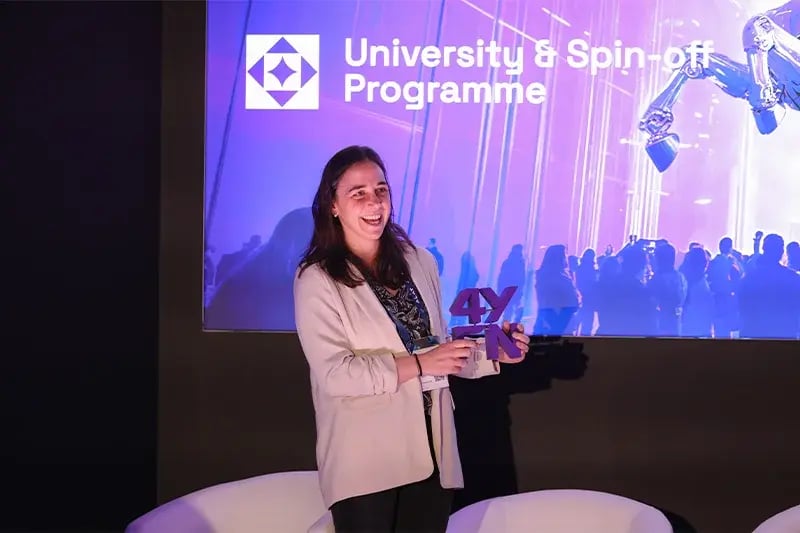
At 4YFN26's Universities & Spin-Offs track, exhibitors will demonstrate what's possible when research excellence meets commercial execution. These aren't academic experiments – they're serious ventures building technologies in quantum computing, precision medicine, advanced materials, and sustainable energy that could define future industries.
Can European institutions build the commercial infrastructure that turns excellent science into excellent businesses? Come to 4YFN26 to find out the answers.
Discover how universities are bridging the lab-to-market gap at /tracks/universities-spin-offs
Track Tags: Universities, Infinite AI, Corporate Innovation, Investors, Health Tech, Climate Tech, Cyber Security, Fintech, Founders Academy