 Skip to main content.
Blog
From Research Lab to Real-World Impact: Meet FloodWaive, 4YFN26 Spin-Offs Pitch Battle Winner
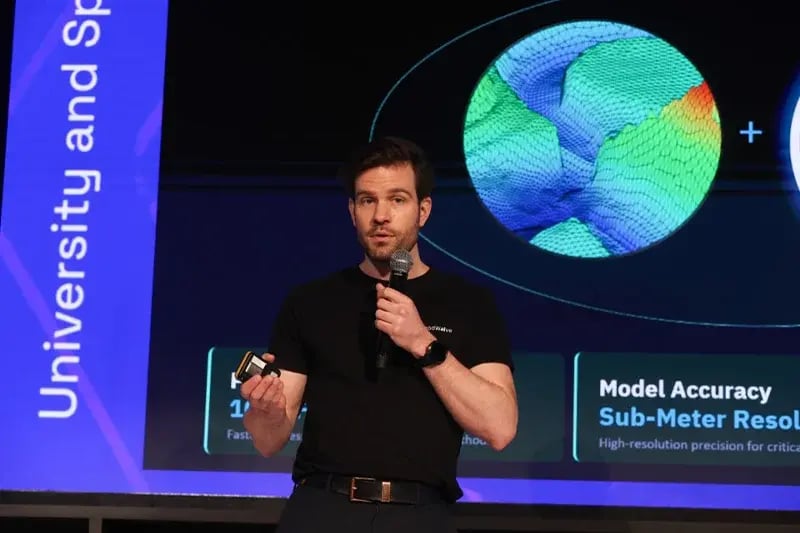
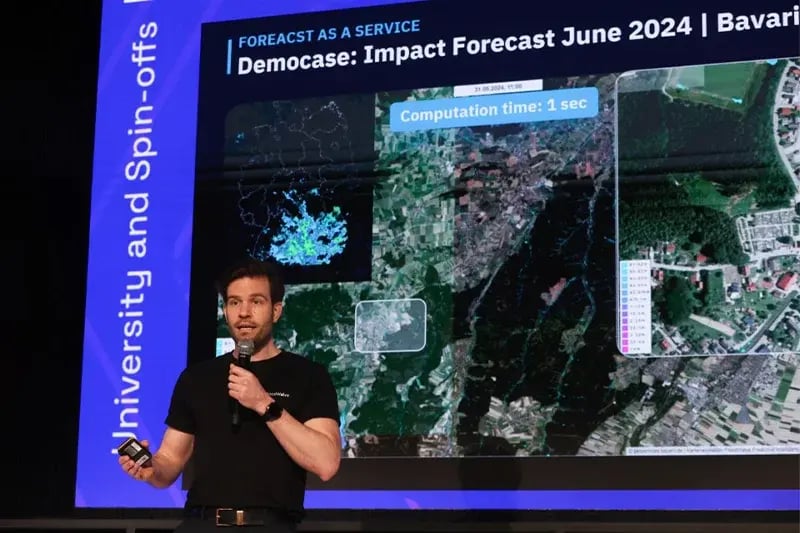
Across Europe and around the world, extreme weather events are becoming more frequent and more severe. Flooding, in particular, continues to pose major risks for cities, infrastructure and communities.
At 4YFN26, one university spin-off stood out for its innovative approach to tackling this challenge. FloodWaive, a startup born from academic research, was named the winner of the 4YFN26 University & Spin-off Pitch Battle, recognising its potential to transform how societies prepare for and respond to flooding.
The Pitch Battle brings together some of the most promising university-born startups and deep tech innovators, showcasing how research developed in labs can translate into real-world solutions with global impact.
We spoke with Dr.-Ing. Julian Hofmann, CEO & Co-Founder at FloodWaive, about their journey from research to entrepreneurship, the technology behind their solution, and what comes next after their win at 4YFN.
1. FloodWaive emerged from academic research to address a growing climate challenge. Could you tell us how the original idea was born and how the journey from university research to startup began?
The idea behind FloodWaive was born in 2018, during my doctoral research at RWTH Aachen University's Institute of Hydraulic Engineering and Water Resources Management (IWW). I was working on flood early warning systems and kept running into the same fundamental gap: we had river gauge forecasts for major rivers, but when it came to the question every decision-maker actually needs answered — "What does this amount of rainfall mean specifically for my location, my street, my building?" — the existing tools fell short. Static hazard maps couldn't reflect dynamic climate conditions, and conventional hydraulic simulations took hours or even days to compute.
That's when the vision of impact forecasting took shape: not just predicting when it rains, but what concretely happens — how high, how fast, how dangerous — at any given point.
Technologically, I began exploring a novel approach: training AI models not on measured data (which is often scarce or unavailable), but on the results of physics-based hydrodynamic simulations. Essentially, one model learning from another model. This makes our technology uniquely powerful in regions with no sensor infrastructure — which is most of the world.
A decisive moment came in 2018 when a severe storm hit Aachen and validated my early models in real-world conditions. Shortly after, I met Adrian Holt, a computer scientist specializing in machine learning, who developed the transformer-based architecture that now underpins our DeepWaive engine. When the devastating Ahr Valley flood struck Germany in July 2021 — killing 189 people and causing over €33 billion in damages — the urgency became undeniable. The demand for our technology exploded, but the university could only conduct research, not deploy commercial solutions.
So in November 2023, we founded FloodWaive Predictive Intelligence GmbH as an official spin-off from RWTH Aachen. With the support of EXIST grants, ESA, and a growing interdisciplinary team, we turned years of cutting-edge research into an operational platform. Today, we are a team of 19 — and we are just getting started.
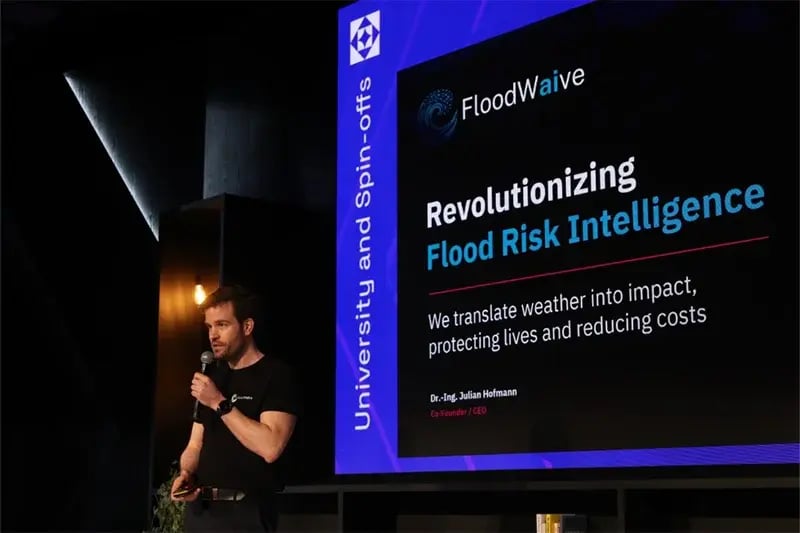
2. Flood resilience is becoming increasingly critical for cities and infrastructure worldwide. What specific problem is FloodWaive solving, and how does your technology help communities better prepare for extreme weather events?
The core problem is a massive decision gap. When extreme rainfall hits, society currently lacks the tools to answer the most critical question in real time: Where exactly will the water go, how deep will it get, and what will be affected?
Traditional systems rely on static hazard maps that fail to reflect climate change or current conditions, or on discharge forecasts limited to selected major rivers. There is no area-wide, site-specific impact forecast available for the places where people live and work. This gap costs lives and causes billions in preventable damage every year.
FloodWaive closes this gap. At the heart of our solution is DeepWaive — the world's first physics-informed foundation model for flood simulation. It combines the accuracy of 2D hydrodynamic models with the speed of deep learning, delivering high-resolution flood predictions up to one million times faster than conventional methods. The speed is a game-changer: we proved that after the 2021 Ahrtal catastrophe, our system could have provided a dynamic flood map 48 hours in advance based on available DWD forecasts.
This gives us three powerful capabilities:
- DeepWaive RiskAnalyzer — on-demand risk analytics for long-term planning, investment decisions, and insurance underwriting.
- DeepWaive Forecast — real-time, impact-based flood warnings that tell emergency responders exactly which streets, buildings, and assets are at risk.
- DeepWaive Operations — a live decision-support tool that lets operators simulate protective measures (mobile barriers, dam controls, evacuation routes) during an unfolding event and see the impact in seconds.
For example, during the catastrophic Bavaria floods in June 2024, our system pinpointed exact water depths down to the street level. And just days before our pitch at 4YFN, the Spanish government called us to deliver a rapid risk assessment for flood-devastated regions in Andalusia — a powerful reminder that this technology is needed now.
We translate weather into impact — protecting lives, critical infrastructure, and economies.
3. Congratulations on winning the 4YFN26 University & Spin-off Pitch Battle. What did this recognition mean for your team, and what were some of the most valuable conversations or connections you made during the event?
Winning the 4YFN Spin-Off Pitch Battle at MWC Barcelona was a defining moment for our team. It validated not just our technology, but the years of research, the long nights, and the conviction that physics-informed AI can fundamentally change how the world prepares for floods.
What made it particularly special was the timing. Just weeks before the event, severe flooding in Spain had once again highlighted the devastating consequences of insufficient early warning systems. When I opened my pitch with the words "On Monday, the Spanish government called us and asked for a rapid risk assessment" — it was not a hypothetical scenario. It was reality. You could feel the audience lean in. That's the moment when deep tech stops being abstract and shows its real impact.
For our team back in Aachen, the recognition sent a powerful signal: what we are building matters on a global stage. It was especially meaningful to receive this in front of an investor jury featuring Vik Li (Ericsson Ventures), Pablo Mosquera Martínez (UNIRISCO), and Almudena Trigo Lorenzo (BeAble Capital) — experienced investors who challenged us with tough questions on go-to-market strategy, scalability, and competitive moats, and were convinced by our answers.
Beyond the award itself, MWC was transformative for our business development. A highlight was presenting on the Deutsche Telekom main stage alongside hubraum, sharing how we co-create AI-driven infrastructure protection — from our first proof-of-concept to an ongoing nationwide trial. We even had the opportunity to present our joint PoC directly to Deutsche Telekom CEO Tim Höttges, who stopped by our booth to meet the teams.
The event opened doors to new conversations with telecom operators, insurers, and critical infrastructure providers across Europe — exactly the sectors we are scaling into.

4. One of the biggest challenges for university spin-offs is translating cutting-edge research into scalable solutions. What have been the key steps in turning your innovation into a product that can be adopted by cities, governments or industry?
This is one of the hardest transitions in deep tech — moving from a research breakthrough to a product that customers trust and pay for. For us, several steps were critical:
First, we validated in the real world early. Even before founding the company, we ran pilot projects with municipalities, water authorities, and ministries. These early deployments were invaluable — not because they generated revenue, but because they forced us to confront the difference between a model that works in a lab and a system that operates under real-world conditions with real security protocols.
Second, we built for integration, not isolation. Our platform is cloud-native and designed to plug into existing customer systems — whether that's a municipal GIS platform, an insurer's underwriting engine, or a telecom operator's infrastructure monitoring. We offer standardized APIs (REST, WMS/WFS) and can be deployed as a white-label solution. This was essential for gaining trust in the public sector and industry alike.
Third, we diversified our customer base deliberately. Public-sector procurement cycles can take up to two years. So, while municipalities remain our foundation — and our passion — we strategically pursued faster-moving segments: insurance companies that need automated risk scoring, utilities that need simulation-as-a-service, and critical infrastructure operators like Deutsche Telekom that need real-time asset protection. This multi-sector approach gave us revenue stability and accelerated our learning.
Fourth, we invested in our team. We grew from 2 co-founders to 19 team members in just over two years, bringing together expertise in hydrology, machine learning, software engineering, and business development. We also maintained a strong research partnership with RWTH Aachen, ensuring a continuous pipeline of scientific innovation and talent.
Today, we serve 10+ paying customers including state governments, partnerships with major water boards, Insurances, and critical infrastructure providers.
5. Looking ahead, what are the next milestones for FloodWaive, and what impact do you hope your technology will have on climate resilience over the coming years?
We are at an inflection point. The technology is proven, the market pull is enormous, and the regulatory environment — from the EU Floods Directive to the Critical Entities Resilience Directive — is accelerating demand.
Our key milestones ahead:
- European expansion: We are already piloting internationally — in Valencia (Spain) for urban flash floods and Canton Valais (Switzerland) for alpine terrain applications. Our next step is systematic expansion across the DACH region, Benelux, and Southern Europe, leveraging the universal availability of Copernicus satellite data and standardized EU terrain models.
- Critical infrastructure at scale: Our partnership with Deutsche Telekom is a blueprint for how AI-driven flood intelligence can protect the backbone of society. We are working to extend this model to energy, rail, and water infrastructure operators across Europe.
- Advancing DeepWaive to a true global foundation model: We are continuously improving resolution, integrating new data sources (ESA Sentinel satellites, real-time sensor networks), and expanding our model's capabilities to cover increasingly complex scenarios — including dam breaks, combined pluvial-fluvial events, and urban drainage dynamics.
- Strategic growth: We are pursuing a funding round with strategic partners to accelerate our go-to-market in insurance, telecom, and international markets, while maintaining the operational profitability we have already achieved.
Our vision goes beyond forecasting. We want to shift the entire paradigm — from reactive damage control to proactive protection. Imagine a world where every city, every insurer, every infrastructure operator has access to real-time, building-level flood intelligence. Where protective measures are deployed before the water arrives. Where investment decisions are based on dynamic, AI-powered risk models instead of outdated static maps.
Flooding is the most costly natural disaster in Europe and globally. With climate change intensifying extreme weather events, the need for intelligent, fast, and scalable flood resilience solutions will only grow. FloodWaive is building that future — and winning at 4YFN has shown us that the world is ready for it.
For more information on our University & Spin-off track visit our website here.