 Skip to main content.
Blog
From Corporate Innovation to Competitive Advantage: How Startup Partnerships Win Tomorrow’s Markets

From BMW to Telefónica, leading enterprises are using startup partnerships to accelerate innovation and capture new markets

Corporate innovation is undergoing a fundamental shift.
Previously, large enterprises relied heavily on internal R&D to build and sustain competitive advantage. Today, innovation increasingly occurs externally, driven by agile startups that can quickly adapt and innovate at the pace markets demand.
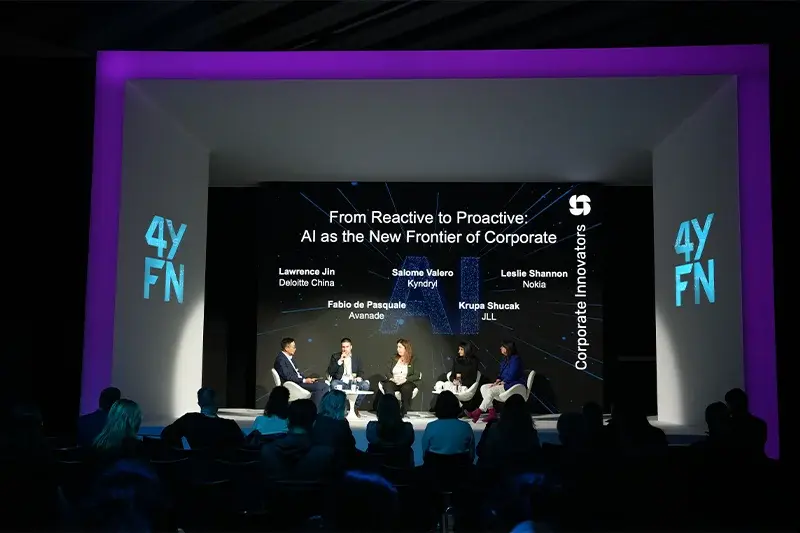
Whilst preparing the Corporate Innovation track for 4YFN26, we’ve seen how enterprises transform how they engage with startups. Whether through direct procurement, strategic partnerships or new venture client models, the most successful corporations are embracing startup collaborations – from problem identification and pilot programmes to full-scale integration.
Strategic partnership models are fast becoming the preferred path for corporate-startup collaboration. Since its launch in 2017, the European Innovation Council's Corporate Partnership Programme has enabled over 1,500 startup-corporate engagements, achieving a 92% satisfaction rate. Meanwhile, companies with dedicated Venture Client Units report being twice as likely to identify quality startup solutions compared to those without.
At the same time, success frameworks are maturing – with BMW's pioneering Venture Client Model now adopted by over 50 corporations across 10+ industries globally. Corporates implementing these structured approaches are not only accelerating their innovation cycles – they're building stronger competitive moats, reducing costs by up to 70% (as Bosch achieved with leading AI video provider Synthesia), and generating billions in new revenue streams.
Telefónica's Wayra, a longstanding 4YFN partner, exemplified this approach at 4YFN25, showcasing how €245 million invested across 1,000+ startups translated into €1 billion in revenue through successful integration of 195 ventures into core operations. Their insight, drawn from years of systematic startup collaboration, demonstrated that partnership success depends on more than capital – it requires operational commitment and cultural alignment.

EY's "Flipping the Script" session at 4YFN25 also addressed a critical truth: successful partnerships depend as much on corporate readiness as startup agility. The most resilient collaborations emerge when enterprises adapt their procurement, compliance and operational models to accommodate the realities of startup innovation – from faster decision cycles to risk-tolerant pilot programmes.
The data reinforces this urgency. With 90% of startups failing overall, but success rates jumping to 30% for founders with corporate backing and experience, the mutual value of strategic partnership is clear. Financial institutions lead the way, with 80% having implemented fintech partnerships – recognising that in an era of rapid disruption, collaboration isn't optional.
While some enterprises still debate the merits of startup partnerships, others are building systematic capabilities that deliver measurable results. The corporations implementing structured collaboration frameworks today are positioning themselves to capture the innovation advantage that will define competitive success in the next decade.
Join us across the Corporate Innovation track in March 2026 to discover the partners and platforms defining the future of open innovation.